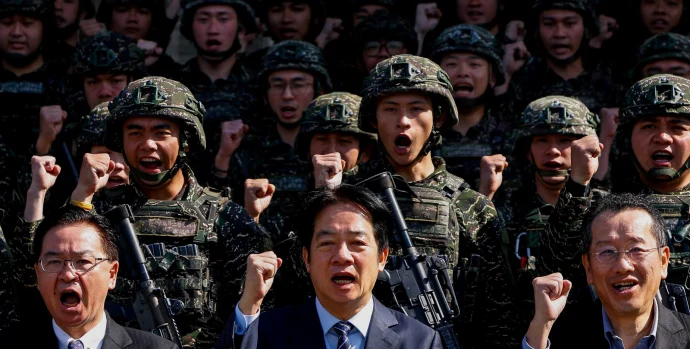
Tensions are rising between Beijing and Taipei in Taiwan, a country of 23.5 million people, raising fears of a sudden escalation into full-scale conflict.
Following a meeting with U.S. Vice President J.D. Vance on democracy in Munich in February, U.S. Secretary of Defense Pete Hegseth sounded the alarm at the Shangri-La Dialogue in Singapore. Speaking on global military tensions, the American official issued another strong warning at this Indo-Pacific security summit, alerting that war could erupt in the Taiwan region.
According to “L’Express,” the Pentagon chief sees China’s behavior as increasingly provocative toward the small democracy of 23.5 million people.
This conflict isn’t new—Washington has long maintained that China must be restrained. On his part, Xi Jinping has never hidden his ambition to “reunify” China and has increased military spending. An attack can’t be ruled out: in the late 17th century, Emperor Kangxi’s army spent a decade preparing to conquer Taiwan—and succeeded.
Now, the U.S. defense minister warns that a military invasion of Taiwan might be approaching, reinforcing America’s stance as the Pacific’s peacekeeper. If war breaks out, it would mean that the U.S. failed to prevent it. That’s why Hegseth raised the stakes in his speech, hoping to make the deterrence against China more credible, explains Jean-Pierre Cabestan, a deputy researcher at the Asia Research Institute.
The Pentagon chief is not alone in sounding the alarm. French President Emmanuel Macron, who recently visited Singapore, also criticized Beijing, saying: “If we accept that Russia can take part of Ukraine’s territory without consequences or international response, why would Taiwan be any different?”
China does not view Taiwan the same way it views Ukraine.
That’s why the Chinese Communist leaders skipped the Singapore summit. They consider Taiwan to be China’s 23rd province. Beijing does not intend to compare this case to Ukraine. That’s been China’s stance since Mao Zedong declared in 1959: “The relationship between China and Taiwan is different from that of divided Germany, the two Koreas, or the two Vietnams.”
Since then, the first two (Germany and Vietnam) have reunified under democratic or communist governments, while Seoul and Pyongyang remain divided.
The Taiwanese people, like Ukrainians, want to preserve their democratic governance.
After World War II, Chiang Kai-shek, leader of the Kuomintang (Chinese Nationalist Party), established the Republic of China (ROC) government in Taiwan in 1949, after losing the civil war to the communists on mainland China. He fled to Taiwan with about two million people, escaping Mao Zedong’s new communist regime.
Chiang formally set up the ROC government in Taipei in December 1949 and continued as president in March 1950. China considers Taiwan as one of its provinces.