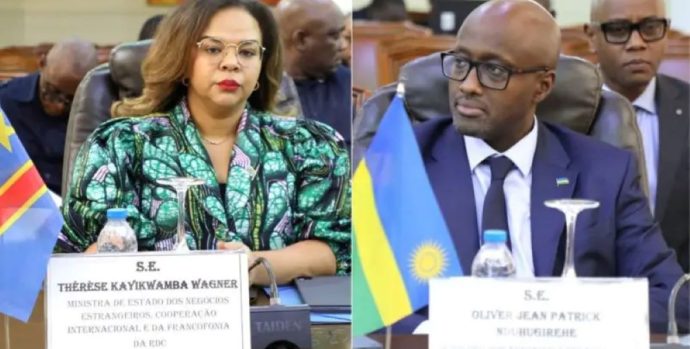
The United States announced that on Friday, April 25, an agreement would be signed between Rwanda and the Democratic Republic of Congo.
This agreement will be signed between Rwanda’s Minister of Foreign Affairs, Amb. Olivier Nduhungirehe, and his Congolese counterpart, Thérèse Wagner Kayikwamba.
The U.S. Department of State announced that both diplomats would be received by U.S. Secretary of State, Marco Rubio.
No detailed information has been provided by the U.S. about the content of the agreement to be signed between Rwanda and Congo.
However, the signing comes after Washington has recently sent its envoys to Kigali and Kinshasa.
Among them is Massad Boulos, President Donald Trump’s advisor on African affairs. This month, he met with Presidents Paul Kagame and Félix Antoine Tshisekedi in Kigali and Kinshasa.
While in Kigali, Boulos told the press that Trump supports restoring peace between Rwanda and the DRC.
The two countries have been in strained relations due to ongoing conflict in eastern DRC, where Congolese forces are fighting the M23 group.
Kinshasa and its allies, including the U.S., accuse Rwanda of backing this group. In another interview, Boulos asked Rwanda to “stop supporting M23 and withdraw all its troops from Congolese territory.”
Trump’s advisor also emphasized that the terrorist group FDLR is a major issue that must be addressed in Rwanda-DRC peace talks, and he discussed the group with President Kagame.
He said: “We really discussed FDLR and the issues it may cause. It’s a crucial part of the peace agreement. It’s important for Rwanda, and it’s key to the peace plan.”
Last year, during the Luanda talks, Rwanda and the DRC had agreed on dismantling the FDLR; however, that was not implemented.
Boulos stated that the U.S. supports this decision and will continue working with stakeholders to eliminate the FDLR. He reiterated that the U.S. supports the sovereignty of both Rwanda and the DRC.
He said: “As I mentioned in my press conference in Kigali, what we want is that the independence and territorial integrity of both countries be respected—not just one.”
He added: “Everyone should feel secure based on those principles and shouldn’t be threatened by current or future issues.”