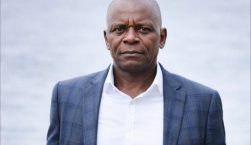
Faustin Musanganya , 65, a resident of Muhoza Sector in Musanze District is one of the Karate legend in Rwanda, who started the sports in his twenties. Aged yet physically fit, Musanganya, is married with five children. He gained Nebraska State citizenship in 1992. He went to a primary school in Burera District in 1962, later Petit Seminaire Rwesero St Dominique Savio doing Latin Sciences. He went to study abroad at Université Catholique de Louvain, Belgium, in 1976 in Philosophie et Lettres. Falling in love with Karate Musanganya says during the first year, he was just travelling in the university campus, when he found a group of people wearing white clothes, moving backwards and forwards without knowledge of what is going on. He felt interested in knowing more about karate and later signed up in the group lead by the then black belt with third Dan, Master Luc Galmart, now holding seventh Dan. Musanganya was welcomed in the group and felt at home, for he says there was no racism and people were friendly. The team was mostly of university students and Musanganya enjoyed Karate. Before acquiring the bachelor’s degree in Education with Aggregation (full teacher) in 1982, he became a karate master with black belt with first Dan while being Captain of the University Karate Club. Later, he returned to Rwanda in 1983, taught literary critics at University of Rwanda and found that Karate was already in the Land of Thousand Hills together with already well known masters: Lecturer and Master at JOC Kigali with black belt, Master Francois Nduwumwe, may his soul rest in peace and Master Theodore Mpatswenumugabo. While teaching French at Nyakinama Campus, Musanganya started with a small group of students and Karate according to him, became famous. Government once banned Karate. However, in 1986, according to Faustin Musanganya, martial arts enthusiasts formed the Association Rwandaise d’Arts Martiaux (ARAM), an association for judo, karate, kungfu and boxing. This was to make Karate an official sport by establishing ARAM. He became vice- President, while Master Francois Nduwumwe headed the new association as Secretary General. Musanganya later became the president and in 1988 was awarded second Dan. He recalls how they invited a Japanese Master with eight Dans, Teruo Kono, may God grant him eternal peace, to grace the event known as passage. Musanganya says Karate has different aspects that are helpful as follow: Sports, arts, self-defence and good health. Besides having worked together with people from different backgrounds, he travelled a lot when he was the captain of Samurai Leuven. He travelled to Germany, United Kingdom, Netherlands, France to name a few and they won medals and trophies and he has got a chance to be trained by the great masters such as Luc Galmart, 7 Dan, Rob Zwartjes, 8 Dan Hanshi, Tatsuo Suzuki, 8 Dan Hanshi, and naturaly Teruo Kono, 8 Dan Hanshi and has got the privilege to catch a glimpse of Hironori Otsuka. Musanganya also established own clubs as Karate was gaining fame. He started with Samurai Kigali at Kabusunzu at Centre Iwacu, when he was working in the office of the president. Later, Meridien International in Meridien Hotel and finally, American Karate Club at Kimihurura. While making comparison, Musanganya says in the past, Karate mainly viewed as a tool for self-defence but nowadays karate seems to be the sport in general. He says Karate in Rwanda is developing quickly with some few challenges but not to the extent, it used to be in the past days. However, he says, there a lot to do like in terms of increasing competition, keep increasing ranks, competition among masters themselves with fair play to share skills and examining. He says young Karate practitioners had better take Master Sinzi Tharcisse an idol for he kept increasing ranks, now sixth Dan. He recognizes that Master Uwayo Théogène, fourth Dan, President of Rwanda Karate Federation and President of Olympic Committee of Rwanda has worked hard to put Rwandan karate on an international stage and that Master Rurangayire Guy, fourth dan, shows that karate is not only a question of kicks but is also and mainly a way to extend relationships profitable for individuals and the country. He blames those who get black belt and feel it is over with Karate. He suggests, they should keep going forward, increasing their ranks. Musanganya claims Rwandan Karate practitioners are doing well globally especially in Kata but there is still a long way to go in combat for he knows what it takes to become good in that area. A cool and eloquent Musanganya, in his opinion, he was strong in combat and wishes young one to put much emphasis in the area. His Challenges in Karate Despite the fact that he likes Karate, Musanganya faced many challenges during his career. Rwandan history prevented him from increasing ranks. Spending two years in DRC as a refugee, family issues after coming back into the country, seven years in jail, are some of the obstacles that Musanganya faced, hence hampering his Karate career. However, Musanganya is fully prepared to undertake the competition for third Dan as he revealed that he has been doing intensive training in order to succeed. “I know I will achieve it at my age.” Very little is known of the exact time ordinary citizens, other than military personnel, begun practicing karate before it was permitted in 1987. Musanganya recalls that before 1983, Master Nduwumwe François, ARAM’s Secretary General, had already started teaching karate. Nevertheless, there is consensus that former Social Democratic Party (PSD) stalwart, Master Francois Nduwumwe, who passed on in 2013, was the first to teach karate. It is thought that this was anywhere between the late 70s and early 80s. In Japan, Shotokan-Ryu, Wado-Ryu, Goju-Ryu and Shito-Ryu are the four main styles of Karate. Shito-Ryu is the style that preserves most of the original Shuri-te techniques. In Rwanda, Shotokan and Wado-Ryu are the most common styles today. Founded in 1936, Shotokan is a style of karate, developed from various martial arts by Great Master Gichin Funakoshi who is attributed as being the ‘father of modern karate. The Wado-Ryu style was founded in 1939 by Professor Doctor Great Master Hironori ?tsuka, another Japanese master well known as being Master of the Masters.

Master Musanganya Faustin, one of the Karate Pioneer in Rwanda/ BWIZA