
The President of The Democratic Green Party of Rwanda, Senator Dr. Frank Habineza has called on governments and environmental organisations to strengthen wildlife protection, warning that armed conflict, habitat destruction and illegal wildlife trade are threatening conservation gains across Africa.
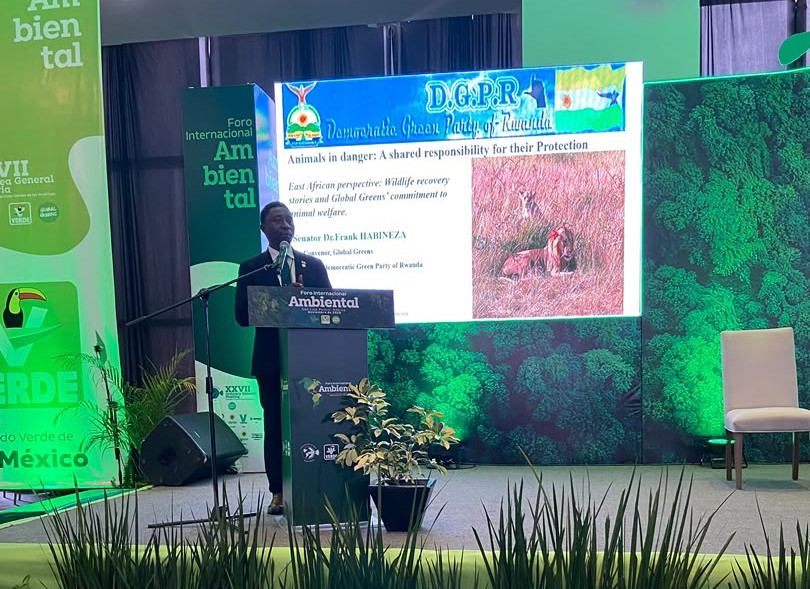
Habineza made the call on November 24, 2026, during the International Environmental Forum held in San Luis Potosí, Mexico, where he participated in a panel discussion titled “Animals in Danger and Understanding Their Suffering.”
The discussion was part of the International Environmental Forum and the 27th Ordinary General Assembly of the Federation of Green Parties of the Americas (FPVA).
In his presentation, Habineza highlighted Rwanda’s conservation achievements, particularly the recovery of Akagera National Park and the growth of mountain gorilla populations.
He said the number of elephants in Akagera increased from 26 in 1975 to at least 150 by July 2026, while the lion population grew from seven reintroduced in 2015 to at least 70 in 2026.
He also noted that Rwanda reintroduced black rhinos in 2017, while 100 white rhinos were translocated to the country between 2021 and 2025.
“This did not happen by accident. It happened because of daily ranger patrols, veterinary care, and strong protection,” Habineza said.
He cited mountain gorilla conservation as another example of Rwanda’s progress, noting that the monitored population increased from 328 in 2018 to 395 in 2024, while the number of gorilla families grew from 21 to 26.
Across the Virunga Massif, shared by Rwanda, Uganda and the Democratic Republic of Congo (DRC), the population increased from 254 in 1981 to 1,063, according to figures presented by Habineza.
The Senator attributed these gains to consistent monitoring, veterinary services, controlled tourism and initiatives such as Kwita Izina.
However, he warned that armed conflict in eastern DRC is undermining wildlife conservation efforts.
“Conflict forces displaced families into forests, stops ranger patrols, and turns protected areas into battlegrounds,” he said.
“We cannot protect animals without protecting people and peace,” he added.
Habineza also urged conservation stakeholders to move beyond measuring success through population figures, arguing that animal welfare should receive greater attention.
“We celebrate rising numbers. But numbers alone are not enough,” he said, calling for greater consideration of animal injuries, diseases, habitat loss, fear and stress.
“Protecting a species means protecting the life of each animal,” he added.
The senator further called for greater involvement of communities living around protected areas, citing Rwanda’s model of allocating 10 per cent of national park tourism revenue to surrounding communities.
According to figures he presented, more than RWF23 billion had been invested in over 1,300 community projects by 2026, including schools, health centres, water infrastructure and employment initiatives.
“When a community sees that a gorilla means a school for their children, they become its best protector,” Habineza said.
He proposed five commitments for the San Luis Pact: protecting forests and wildlife corridors, enforcing laws against poaching and illegal wildlife trafficking, sharing tourism benefits with local communities, integrating animal welfare into climate and biodiversity policies, and protecting conservation workers during armed conflicts.
He also called on countries to report annually on progress in implementing the commitments.
“Animals cannot speak for themselves. If we do not speak for them, no one will,” he said.
The environmental forum brought together representatives of Green political parties from different countries and continents.
Its conclusions are expected to inform the San Luis Pact, scheduled for presentation and signing on November 25, 2026.