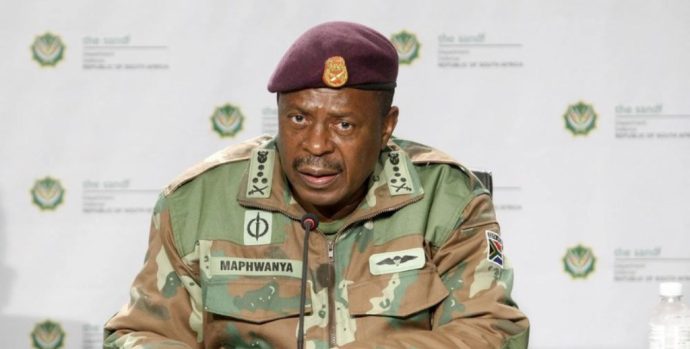
The Chief of the South African National Defence Force (SANDF), General Rudzani Maphwanya, has dismissed claims that the Southern African Development Community Mission in the Democratic Republic of Congo (SAMIDRC) failed in its mandate. He insisted the mission contributed meaningfully to peace efforts in the region.
Speaking at a press briefing in Pretoria on Sunday, May 4, 2025, convened to update the public on the withdrawal of SAMIDRC forces from the DRC, Maphwanya was asked directly whether the mission had failed to meet its objectives.
He responded:
“The goal was mainly to see if peace and stability could be achieved — through mediation and political dialogue. We firmly believe SAMIDRC played a significant role in pushing for peace. Peace remains our ultimate goal.”
South Africa, Malawi, and Tanzania — the three countries contributing troops to SAMIDRC — began withdrawing their forces and equipment following a decision at an extraordinary SADC summit on March 13 to end the mission’s mandate.
South Africa’s Minister of Defence, Angie Motshekga, told reporters:
“This withdrawal follows extensive diplomatic engagements, high-level consultations, and progress in peace initiatives in Eastern DRC.”
She explained that bilateral and multilateral meetings between the DRC government and regional partners had led to a peace agreement between Kinshasa and the M23 rebel group.
“This agreement, brokered with the support of SADC, the African Union, and the East African Community, includes a ceasefire, disarmament, and reintegration of former combatants,” Motshekga said.
The minister emphasized that the withdrawal of SAMIDRC troops marked a “new chapter in regional peacekeeping efforts.” She added that it reflected the DRC’s growing commitment to addressing its internal security challenges and a reduction in the need for foreign troops — all supported by ongoing diplomatic cooperation and development initiatives.
General Maphwanya added:
“We cannot chase after peace endlessly… mediators must take the lead.”
He stressed that the withdrawal should be seen as part of a broader political process aimed at achieving lasting peace and stability.
“This is not a retreat by accident. We are leaving with pride, knowing there are signs of peace taking root,” Maphwanya said.
However, military analyst Dean Wingrin offered a critical perspective. He noted that when M23 rebels captured Goma and moved toward Sake — where SAMIDRC’s headquarters were located — and later South Kivu’s capital, SADC forces were essentially powerless.
“I don’t think SADC leaders had much choice in their March 13 decision to halt the mission,” Wingrin observed.
He argued the mission was under-resourced and undermanned from the start.
“The DRC government refused to negotiate with the M23 and other rebel groups until after key cities like Goma and Bukavu fell. By then, SAMIDRC was little more than a bystander, and the Qatar-brokered talks temporarily halted the fighting,” he added.
“SAMIDRC, in reality, had already failed.”
Last week, SAMIDRC troops began withdrawing from their positions in Sake and Goma, moving overland through Rwanda to assembly points in Tanzania before returning to their home countries.
“The movement started on April 29 with 13 trucks. A vanguard of 57 personnel is already at forward positions ready to receive our troops. The second phase is leaving today, and the full withdrawal will be completed by the end of the month,” Maphwanya explained.
He assured that no South African military presence would remain in eastern DRC after the pullout. South African troops will fly home from Tanzania, while equipment will follow by sea.
Lieutenant General Siphiwe Lucky Sangweni, responsible for joint operations, said the first SANDF soldier reached Tanzania on April 30. The withdrawal took longer than expected due to poor roads and mechanical breakdowns.
Since the Goma airport remains under M23 control, troops and equipment must exit through Rwanda.
Wingrin noted:
“The last thing South African and SADC leaders wanted was to see SADC forces having to exit through Rwanda, escorted by Rwandan troops, to reach northern Tanzania.”
He also mentioned that with the SAS Drakensberg — South Africa’s support vessel — out of commission, SANDF may need to charter a ship to transport its military hardware.