
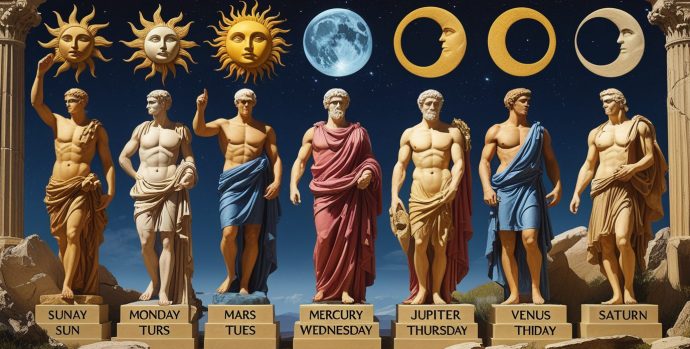
A 24-hour cycle is what we call a day. When repeated seven times, it gives us seven days, which we call a week. Each day has its own name, derived from gods worshiped in ancient times.
Here’s how the names of the days of the week originated from pagan gods, their history, and how they contrast with Christian beliefs:
1. Monday
This day originates from the Moon, seen as a powerful deity in Roman, Babylonian, and Egyptian cultures. The Moon was considered the ruler of darkness and night life.
Naming a day after the Moon reinforced beliefs in lunar prophecies and rituals tied to natural forces, often conflicting with the Christian belief in one true God. This foundation later evolved into occult practices like astrology. Many Christians fall into the sin of trusting horoscopes over God’s guidance.
Isaiah 47:13-14 warns: “All the counsel you have received has only worn you out! Let your astrologers come forward, those stargazers who make predictions month by month, let them save you from what is coming upon you. Surely they are like stubble; the fire will burn them up.”
2. Tuesday
Tuesday is named after Mars (Tiw in Norse mythology), the god of war and strength. Romans honored Mars as a protector of the state, especially in warfare.
Mars promoted violence and warlike strength, which contrasts with Christianity’s teachings of peace and love. Today, many twist Christian values to justify conflict instead of following Christ’s example of forgiveness.
Matthew 5:9 says: “Blessed are the peacemakers, for they will be called children of God.”
3. Wednesday
This day comes from Mercury (Woden in Norse mythology), the god of communication, commerce, and wisdom. Mercury was seen as a mediator between gods and humans, often revered by merchants.
This belief encouraged the idea of needing intermediaries between God and man, undermining Jesus Christ’s unique role.
1 Timothy 2:5 states: “For there is one God and one mediator between God and mankind, the man Christ Jesus.”
Mercury also symbolizes materialism and greed, leading people to value wealth over spiritual growth.
1 Timothy 6:10 warns: “For the love of money is the root of all evil.”
4. Thursday
Named after Jupiter (Thor in Norse mythology), the king of the gods, ruler of thunder and the skies. Romans honored Jupiter as the supreme deity.
This directly opposes Christian belief in one all-powerful God. Jupiter also promoted pride and dominance, values condemned in Christianity.
James 4:10 teaches: “Humble yourselves before the Lord, and He will lift you up.”
5. Friday
This day comes from Venus (Freya/Frigg in Norse mythology), goddess of love, beauty, and pleasure. Ancient rituals under Venus often promoted immorality and lust.
Venus emphasized sensuality and impurity, opposing Christian principles of purity. Today, this influence is seen in media that glorifies promiscuity over family values.
1 Corinthians 6:18 says: “Flee from sexual immorality. All other sins a person commits are outside the body, but whoever sins sexually, sins against their own body.”
6. Saturday
Derived from Saturn, the god of agriculture and prosperity. The Romans celebrated Saturnalia with feasts and excess.
These celebrations contradicted Christian values of moderation and humility. Even today, Saturday is often dedicated to entertainment and indulgence, leading many away from spiritual practices.
Galatians 5:19-21 warns against drunkenness and debauchery, labeling them as works of darkness.
7. Sunday
Named after the Sun, worshiped as a god in cultures like ancient Egypt and Rome. Sun worship was deeply rooted, especially among Romans who revered Apollo.
This practice placed creation above the Creator, conflicting with Christian teachings. However, Christians eventually reclaimed Sunday as a holy day, celebrating Christ’s resurrection.
Even today, people often focus on nature and earthly pleasures, neglecting the Creator Himself.