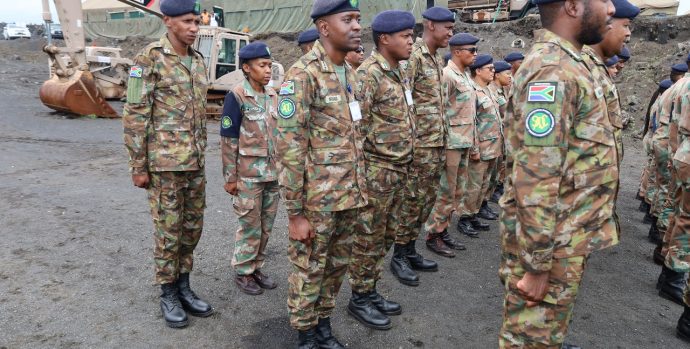
The opposition party Democratic Alliance (DA) has rejected claims by the South African National Defence Force (SANDF) that the SAMIDRC mission in the Democratic Republic of Congo (DRC) was a success. This comes in the wake of the deaths of 14 South African soldiers killed by M23 rebels in late January, and the conclusion of the mission.
Last Friday, Defence Minister Angie Motshekga was expected to brief Parliament on the withdrawal of troops and equipment from the Southern African Development Community (SADC) mission in the DRC (SAMIDRC), whose mandate ended on March 13.
Nicholas Gotsell, a DA Member of Parliament on the Defence and Justice Committee, said his party would use the opportunity to raise concerns over SANDF allegedly spreading misinformation, according to DefenceWeb.
“The deaths of 14 South African soldiers and the injuries of another 174 — brave men and women sent to a conflict zone without air support or adequate equipment — are no victory. This is a national tragedy,” Gotsell stated.
On Sunday, Minister Motshekga and SANDF Chief General Rudzani Maphwanya said the SAMIDRC mission — largely composed of South African, Tanzanian, and Malawian troops — was successful in contributing to peace efforts in Congo. However, cities such as Goma and Sake in North and South Kivu remain under rebel control, and fighting continues despite ongoing peace talks.
African military analyst Darren Olivier stated: “It is right to question so-called ‘success’ and demand clarity.” He added: “To me, the mission failed. It lacked manpower, air support, proximity bases, and had no viable Plan B.”
He continued: “Realistically, SAMIDRC and SANDF could not independently prevent M23 and Rwandan forces from advancing toward Sake and Goma while FARDC faltered. Stopping them would have required far greater strength.”
Olivier also noted that MONUSCO forces, including South Africans, fought hard during Operation Springbok III to stop the M23 advance, losing peacekeepers in the process. However, MONUSCO later halted fighting and engaged in ceasefire talks after FARDC was defeated — much like SAMIDRC did.
He concluded by encouraging deeper parliamentary scrutiny into SAMIDRC’s failures and their implications for SANDF, saying, “Hopefully this leads to major reforms and more support for SANDF.”